Focused actionable insight

DTG Focus takes what your site is measuring and turns it into the handful of things that actually need a decision.

What it is

Monitoring data stops being a pile of feeds and starts being a picture.

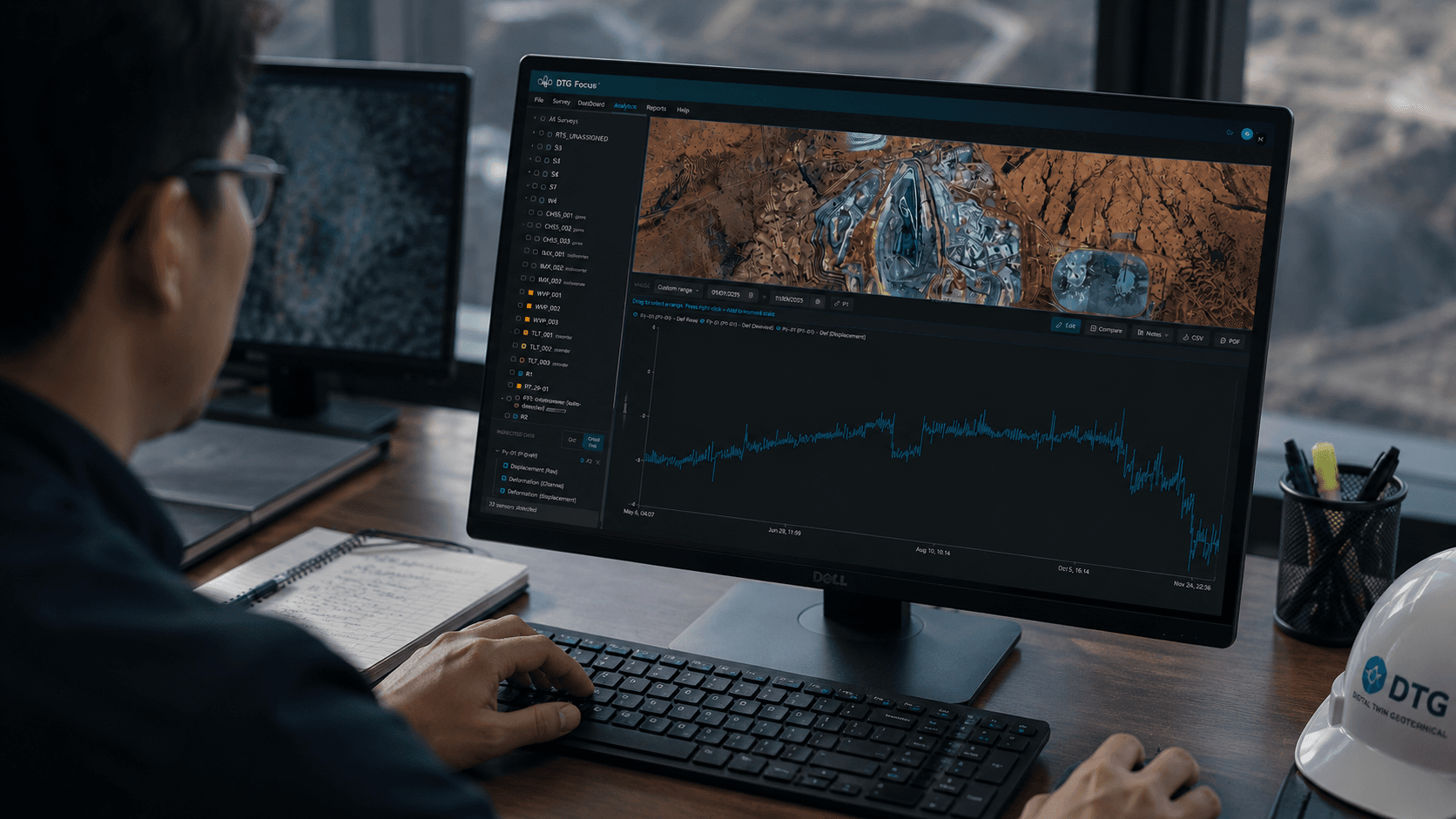
Radar, GNSS, prisms, InSAR, inspections — normally that means a different window for each, and an engineer holding the whole thing together in their head. DTG Focus puts them in one view: the map, the trends beside it, the data quality checked, and the review record built as you go.

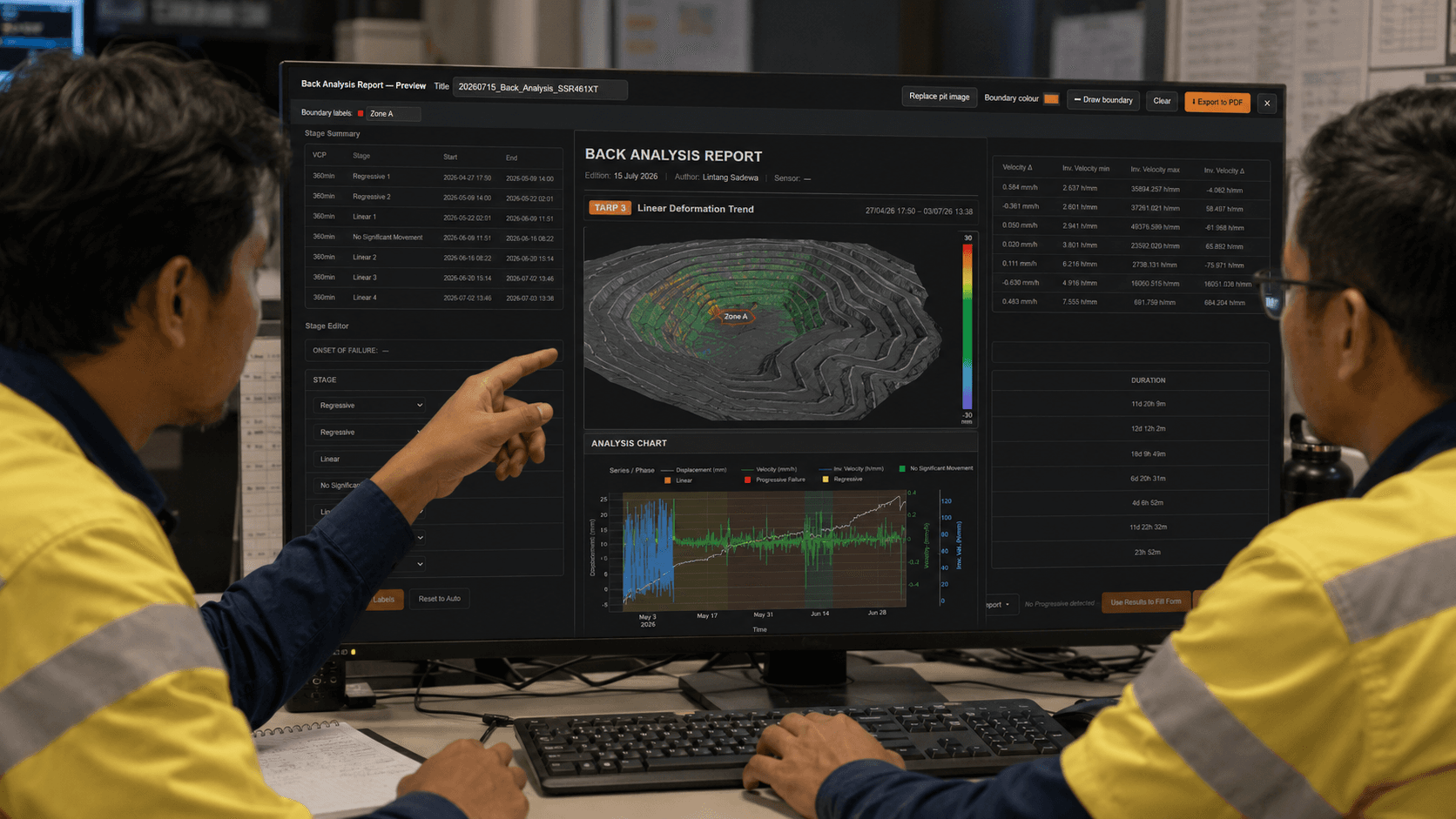
DTG Focus software showing every monitoring source in one review environment — an aerial map with deformation overlay and a trend chart beside it.
DTG Focus — every monitoring source in one review environment.

Your sources, one view

Your technologies read together, not in separate windows.

Trends beside the map

Where it's moving and how it's been moving, on one screen.

Quality checked first

Bad data flagged before anyone interprets it.

The record writes itself

What was reviewed, and when — captured as you work.

Who it’s for

Three people need three different things from the same data.

A monitoring technician, a site geotech and a corporate principal are all looking at the same sensors — and none of them need the same screen. DTG Focus gives each of them theirs.

Monitoring teams

The people watching the sensors

Your monitoring on one screen — alarms in context, movement against history, and the review recorded as it happens rather than reconstructed afterwards.

  • Live map and trend review together
  • Alarms with the surrounding evidence
  • Data quality flagged automatically
  • Review notes captured in-flow
  • Escalation context ready to hand
  • Nothing waiting on a manual export
Site engineers

The people who have to make the call today

What is the ground doing right now, and what does it mean for the plan? Daily operational condition at a glance — without spending the first hour of the day assembling it from four systems.

  • Today's ground condition, immediately
  • Movement history and rate of change
  • Cross-sensor agreement made visible
  • Context for operational decisions
  • Evidence assembled, not hunted for
  • Defensible record behind every call
Corporate & group geotech

The people accountable across every site

Are the sensors actually working? Is the data any good? Is each site running monitoring the way it's supposed to? Portfolio visibility without ringing every site to ask.

  • Sensor health and uptime across sites
  • Data quality and completeness
  • Monitoring performance, compared
  • Review discipline made visible
  • Assurance evidence in one place
  • Consistent standards, site to site
Inside DTG Focus

Five capabilities, running together.

Each one is substantial on its own. The point is that they run in the same place, on the same data, at the same time — which is the part that has never existed.

Integration

Your sources, one place

Radar, GNSS, prisms, InSAR, LiDAR, piezometers, seismic — across any vendor, read together instead of in six separate windows. Nothing on your site gets replaced to make it fit.

Analytics

The processing underneath

Data quality assessed across your connected sensors, noise separated from real movement, trends resolved from messy signal, and developing change surfaced early — running continuously, so people aren't doing it by hand.

Review & workflow

Built for how monitoring runs

Alarms arriving with their evidence, escalation aligned to your TARP, and the review captured as it happens — shaped around the routines your team already works to.

Governance & reporting

The decision, documented

What was seen, who reviewed it, what was decided and when — captured as the work happens. Reports and back-analysis build from that record rather than being reconstructed from it, so a call made today can still be explained next year.

Portfolio view

Your sites, compared

Sensor health, data quality and monitoring performance across the whole group — so corporate can see how each site is really running without ringing them to ask.

DTG Focus back-analysis report — a pit deformation model with velocity and inverse-velocity analysis assembled from the monitoring record.
One example: integrated back-analysis reporting — the report assembled from the monitoring record itself, not rebuilt by hand afterwards. One of many things running behind the capabilities above.
How you get it

We start from what your teams need to see.

Focus isn't a box you buy and then work out what to do with. We look at your operation, your sensors and the people who need the information — then set up the views that actually serve them.

  1. Tell us what you're monitoring

    What's on site, what your teams are trying to see, and where the current process costs you time.

  2. We connect what you already run

    Focus works with your existing sensors and platforms across vendors. Nothing gets replaced to make it fit.

  3. Your teams get their view

    Monitoring, engineering and corporate each see what they need — the same data, three ways.

  4. It grows with the operation

    Start with what matters most and extend it. We build the next piece around what you actually use.

Signal to decision

Five things have to happen before a monitoring decision means anything.

Every one of these is done today, somewhere — in a spreadsheet, in someone's head, in an email at 2am. DTG Focus does all five, in one place, on the same data.

See it

Your sources in one view. Radar, GNSS, prisms and InSAR together — not scattered across six windows and one engineer's memory.

Trust it

Quality assessed continuously across your connected sensors. Gaps, drift, noise and a quietly failing instrument surfaced early, because everything after this depends on the data being real.

Understand it

One sensor is an opinion. Four technologies read against each other is evidence — and where they disagree is often where the answer is.

Act on it

Out of thousands of readings, the handful that need a person. Surfaced early, with the context already assembled around them.

Defend it

What was seen, what was decided, who was told and when — recorded as the work happens. So when someone asks why, a year later, the answer is already there.

Five separate jobs, done in one place, on the same data, as the work happens. That is the part that has never existed — and it is what DTG delivers today, starting from whatever your teams most need to see.

DTG Focus

See it on your own data.

Tell us what you're monitoring and who needs to see it — we'll show you what DTG Focus would do with it.

Talk to DTG