
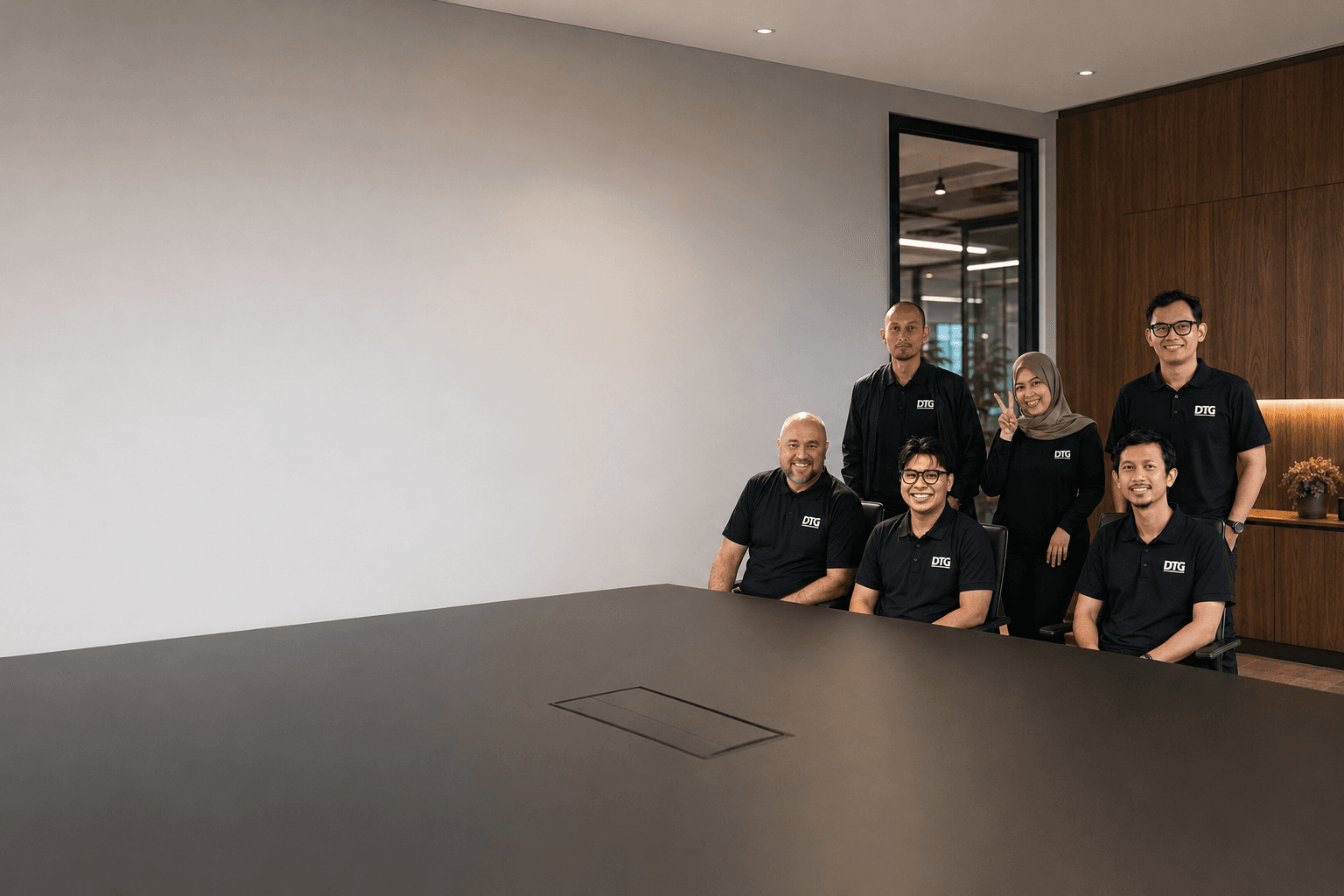

About DTG
Who we are
An independent geotechnical monitoring, analytics and decision-support company — the layer between your instruments and the decisions you have to defend.
The monitoring gap
More data does not automatically create clearer decisions.
Monitoring technology has advanced faster than the systems used to interpret, govern and act on it. The market has strong technology providers.
The missing layer is independent responsibility for monitoring outcomes — across mixed technologies, teams and workflows. That layer is what DTG is, and we’re accountable for it. Not advising from the sidelines.
What we do
Five capabilities. One independent layer.
Independent monitoring reviewLive and scheduled review of monitoring data, alarms and TARP-based escalation.Reporting & back-analysisIndependent reports, event reviews and failure back-analysis.Technology integrationVendor-independent review and integration across monitoring systems.Data analytics & automationCleansing, correlation, trend analysis and repeatable reporting.Technical advisoryMonitoring strategy, governance, escalation design and capability transfer.
How DTG works
Inputs, independent review, governed outcomes.
Your data goes in. Our review sits in the middle. What comes out is a decision that holds up.
Inputs · yours
Whatever you already run
Across any vendor or platform. We don’t ask you to standardise, or replace what works.
- Slope stability radar
- GNSS and prisms
- InSAR and LiDAR
- SLAM LiDAR
- Piezometers, extensometers
- Seismic and site records
This is DTG
Independent review · ours
Engineering judgement, applied continuously
Everything above arrives as raw data. It leaves as something a person can act on. This is the work in between — and the part nobody else is doing independently.
- ValidateQuality, gaps, drift and sensor health checked before anything is interpreted. Bad data is caught here, not downstream.
- CorrelateYour sources read against one another, so a precursor a single sensor might miss can surface for review.
- InterpretExperienced judgement on what the ground is actually doing, with assumptions and uncertainty stated.
- GovernThresholds, TARP-aligned escalation, and a traceable record of who was told what, and when.
Outcomes · yours
Something you can defend
Not a dashboard. A position, with the reasoning attached.
- Escalation that fires when it should
- — and not when it shouldn’t
- Interpretation with its limits stated
- Records that hold up in audit
- Traceable decisions
- Your engineers freed for engineering
Purpose & principles
The principles that protect decision quality.
Technical judgement, not just data
Experienced review helps teams understand what the data means.
Validation before action
Signals are checked for quality, reliability and operational context.
Context over isolated alarms
Alerts are interpreted alongside related systems, events and observations.
Independent review that builds confidence
Technology-agnostic assessment clarifies what the evidence supports.
Governance that supports escalation
Traceable workflows help teams know what changed, who reviewed it and why.
Outcomes that stand up in the field
Monitoring review is shaped around decisions that can be defended.
Vendor independence
Independence does not mean anti-vendor.
Strong monitoring depends on good technology and good implementation. Independence means keeping the monitoring requirement at the centre of the decision — not the product.
Independent DTG review
Vendor-led assumptions
Requirement-first
Technology-first
Technology-agnostic
Brand-specific workflow
Cross-system interpretation
System-limited interpretation
Evidence and context-led
Performance claims without context
Decision-focused and traceable
Reporting shaped by platform capability
Technical assurance
Four questions we ask of every monitoring system.
Assurance isn’t a checklist completed at the end of a project. It’s a structured way of asking whether monitoring information can be trusted, understood and defended.
Is the data reliable enough?
Review availability, continuity, noise, gaps and instrument behaviour — before interpretation.
Do the sensors agree?
Compare technologies and observations to make agreement, delay or contradiction visible.
Is interpretation defensible?
Record evidence, assumptions, uncertainty, recommendations and review logic.
Can teams respond with confidence?
Connect technical review to responsibilities, decision records and change control.

FAQs
Clear answers, without positioning.
Does independence mean DTG is anti-vendor?
No. Good monitoring depends on good vendors, good equipment and good implementation. Independence means assessing options objectively and keeping the monitoring requirement at the centre of the decision.
Is DTG Focus™ a standalone product?
DTG Focus™ is DTG's own monitoring software — built and running, and used in how we deliver monitoring for clients. It's not shelf software you buy and run in isolation: individual capabilities are set up for your operation on request, alongside DTG's review. It works with your existing sensors and systems rather than replacing them.
Is technical assurance the same as data quality control?
No. Data quality control is one part of assurance. Technical assurance also considers configuration, alarm logic, multi-sensor correlation, interpretation, escalation, reporting and governance.
Does DTG replace the client geotechnical team?
No. DTG supports client teams by providing independent monitoring review, technical interpretation, workflow support and decision confidence.
Do we need DTG Focus™ to work with DTG?
No. DTG's review, analytics, governance and advisory work stands on its own. DTG Focus™ is our own monitoring software — we use it in how we deliver, and individual capabilities can be set up for your operation on request — but nothing about working with DTG depends on it.
Does AI make the monitoring decisions?
No. DTG's position is engineering judgement supported by advanced analytics. AI and automation assist review and reporting; they never replace engineering judgement or autonomously identify failures.
Start a monitoring conversation
Talk to DTG about decision quality.
Tell us what you're monitoring, and where it's falling short. We'll be straight about what we'd bring.
Contact DTG